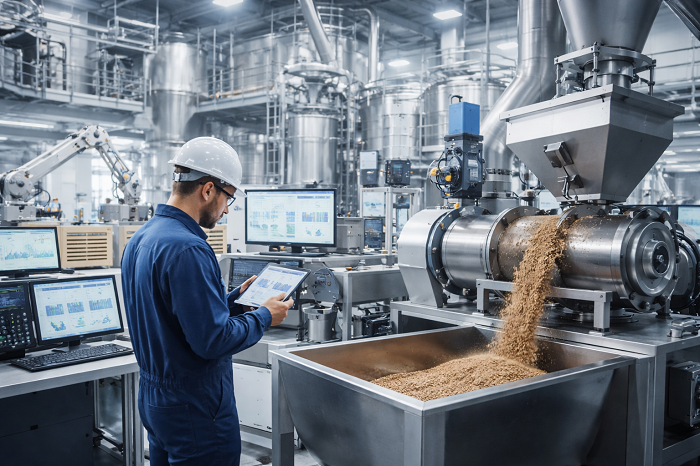
The feed sector is moving far beyond traditional grinding, mixing, and pelleting. Today, the most competitive plants are using smart automation, real time sensing, advanced process control, and new ingredient technologies to improve consistency, reduce waste, strengthen traceability, and protect margins. Equipment suppliers such as Bühler and ANDRITZ now position digitalization, automation, energy efficiency, and higher process control as core parts of modern feed production, not optional add ons.
Why technology matters more than ever in feed manufacturing
Feed manufacturers are under pressure from every direction, ingredient variability, tighter quality expectations, energy costs, biosecurity risks, and the need for better documentation across the supply chain. That is why the latest technologies are focused on precision. The goal is no longer simply to produce more feed, but to produce more consistent, traceable, efficient, and value optimized feed every single shift.
1. Smart plant automation and SCADA systems
The first major technology shaping the industry is full plant automation. Modern control systems allow feed mills to monitor each production stage from intake to final dispatch through centralized interfaces. ANDRITZ states that its automation systems improve feed quality through full process control and built in traceability, while also integrating with plant and ERP systems. This matters because better automation reduces operator dependency, improves repeatability, and shortens the response time when conditions change during production.
2. End to end traceability platforms
Traceability has become a technology category of its own. In modern feed plants, the system must connect recipes, lot numbers, ingredient flow, machine settings, and finished product data in one digital chain. ANDRITZ highlights full traceability of ingredients and process parameters in its feed plant solutions, while Bühler’s myBühler portal gives customers centralized digital access to machine, parts, and asset information. Together, these tools help manufacturers document compliance, investigate quality deviations faster, and build stronger customer trust.
3. Cloud based analytics and AI driven optimization
Another major shift is the rise of cloud connected optimization tools. Instead of relying only on manual checks, feed plants can now use digital services to analyze process performance continuously and identify yield or energy losses. Bühler’s MoisturePro is one example, a cloud based service designed for food and feed dryers that improves yield and lowers energy use by reducing moisture deviations. This shows how feed manufacturing is moving toward predictive, data led decision making rather than reactive correction.
4. Inline NIR sensors for real time quality control
Near infrared sensing is one of the most practical technologies in modern feed manufacturing. Online NIR systems can measure moisture, oil, temperature, and other critical parameters directly in the process, without waiting for delayed lab results. KPM Analytics notes that its online sensors provide rapid, continuous analysis to help operators maintain product quality, increase yield, and minimize waste. For feed mills, that means tighter control over raw materials and finished feed consistency, especially when ingredient variability is high.
5. High precision dosing and weighing systems
Precision formulation only works when dosing and weighing are equally precise. Bühler emphasizes that recipe quality depends heavily on accurate dosing and weighing of ingredients in mixed feed, particularly in premix and concentrate production where inclusion rates are critical. This technology is important because even small deviations in micro ingredients can affect nutrition, compliance, cost, and batch uniformity. As a result, precision dosing is now a foundational technology rather than a support function.
6. Energy efficient grinding technology
Grinding remains one of the biggest energy users in a feed plant, which is why new hammer mill designs are receiving so much attention. Bühler says its Granulex 5 series offers more than 10 percent reduction in energy consumption, more than 10 percent increase in throughput, and more than 50 percent reduction in changeover times. In practical terms, better grinding technology improves particle size consistency while lowering operating costs and downtime, making it one of the highest impact upgrades available to feed manufacturers.
7. Fast, hygienic, low residue mixing systems
Mixing technology has also advanced significantly. Modern batch mixers are designed not only for speed, but also for hygiene and cross contamination control. Bühler’s Speedmix, for example, is built for high output with short mixing times, while its hygienic design helps minimize residues between batches. In feed manufacturing, where formula changes are frequent and contamination control is crucial, improved mixing technology directly supports both quality assurance and operational efficiency.
8. Next generation pellet mills
Pelleting technology is becoming smarter, larger in capacity, and more energy conscious. Bühler’s Kubex T 7 Series was developed for high capacity animal feed pelleting and can reduce energy consumption by up to 10 percent through a direct drive design, while also offering anti blocking protection and easier maintenance access. This type of pellet mill technology helps manufacturers handle difficult recipes more reliably, improve uptime, and produce higher volumes from a compact footprint.
9. Advanced conditioning, extrusion, and vacuum coating
Process control before and after pelleting is another area of rapid innovation. ANDRITZ notes that extrusion control systems provide precise control over conditioning parameters such as speed and temperature, which are essential for product consistency and safety. At the finishing stage, vacuum coating technology allows high levels of liquid addition with efficient micro liquid application and gentle product handling. For feed producers, especially in aqua feed, pet food, and specialty feeds, these technologies improve nutrient delivery, product uniformity, and value addition.
10. Novel ingredient processing, especially insect protein technology
One of the newest technology frontiers is ingredient innovation itself. Bühler’s insect technology solutions are designed for industrial scale conversion of organic residues into protein ingredients for feed, covering steps from feedstock handling to rearing, separation, and extraction. This matters because future ready feed manufacturing is not only about processing conventional ingredients better, it is also about building systems that can handle sustainable new protein sources efficiently and at scale.
Conclusion
The Top 10 Latest Technologies in the Feed Manufacturing Industry show a clear pattern, the future belongs to feed plants that are more connected, more precise, more efficient, and more flexible. Automation, traceability, inline sensing, precision dosing, advanced grinding, hygienic mixing, next generation pelleting, controlled extrusion, smart coating, and novel ingredient processing are no longer distant concepts. They are the technologies that will separate average operations from market leaders. For SEO and internal linking, this topic also connects naturally with content on feed formulation, pellet quality, feed safety, livestock nutrition, and manufacturing automation. Businesses that invest early in these areas will be in a much stronger position to grow profitability and long term resilience.